Telecommunications Software Development: A Complete Guide App Development
Telecommunications software development is the foundation of modern digital communication, enabling seamless connectivity, efficient operations, and innovative service delivery. This guide explores the latest trends, including AI integration, SDN/NFV, cloud solutions, and analytics, while comparing custom-built and off-the-shelf software options. It also covers planning, development steps, and criteria for selecting the right telecom software solution and development partner. Whether focusing on telecom software development in the USA or globally, leveraging expert partners like Progatix ensures scalable, secure, and future-ready telecom applications.
Introduction
Telecommunications technology reinforces almost every aspect of modern life. From the moment you unlock your smartphone to when you complete an online purchase, billions of invisible interactions are routed across networks and servers. Behind each simple tap or swipe lies complex telecommunications software development that ensures seamless connectivity, agile service delivery, and robust network performance.
This guide explores everything you need to know about telecom software development, from emerging trends and planning considerations to custom vs. off-the-shelf solutions, key technologies, development steps, and criteria for choosing the right solution. Whether you are interested in telecom software development in the USA or looking to build custom telecom solutions globally, this guide has you covered.
Telecommunication Software Development Market Size
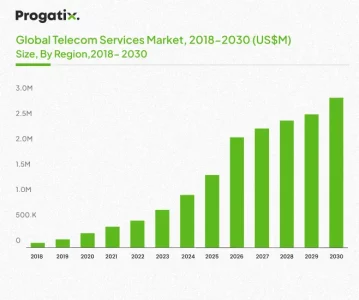
Telecommunications software development is gaining momentum alongside the rapid expansion of the global telecom industry. According to Grand View Research, the global telecom services market was valued at USD 1,983.08 billion in 2024 and is expected to reach USD 2,874.76 billion by 2030, growing at a compound annual growth rate (CAGR) of 6.5% from 2025 to 2030. This sustained growth is being driven by rising data consumption, 5G rollouts, cloud adoption, and increasing reliance on software-driven network infrastructure, making advanced, scalable telecom software solutions a strategic priority for service providers worldwide.
Telecommunications Software Development Trends
Telecommunications software is evolving at an unprecedented pace to meet consumer expectations for reliability, speed, and intelligent service delivery. Below are the leading trends reshaping the telecom landscape:
Software-Defined Networking (SDN) and Network Function Virtualization (NFV)
Telecom software development has shifted dramatically from hardware-centric models to software-driven architectures. SDN separates the control plane from the data plane in a network, allowing centralized control and dynamic traffic management. NFV, on the other hand, removes reliance on physical equipment by virtualizing network functions, making services easier to deploy, scale, and manage.
Together, SDN and NFV reduce operational costs, improve scalability, and enable telecom providers to innovate rapidly. These technologies are fundamental to modern 5G software solutions, cloud-native networks, and next-generation telecom services.
Request a telecom software consultation
Let's Connect
AI and Machine Learning Integration
Artificial intelligence (AI) and machine learning (ML) are no longer optional in telecom software; they are essential for differentiation and efficiency:
- Network management software uses AI to analyze traffic patterns and dynamically optimize performance.
- Predictive maintenance detects issues before they cause service interruptions, reducing downtime and maintenance costs.
- Customer experience tools, including chatbots and recommendation engines, provide instant, personalized support.
- Telecom security software uses AI to detect anomalous activity and block threats in real time.
Collectively, AI-powered telecom solutions are transforming operations and customer engagement.
Low-Code and No-Code Development
Telecom companies adopt low-code and no-code platforms to accelerate telecom app development without heavy reliance on IT specialists. These tools enable rapid prototyping, shorten development cycles, and empower non-technical stakeholders to contribute to solution design, speeding up digital transformation initiatives.
Open APIs and Ecosystem Innovation
Telecom APIs unlock connectivity and collaboration. Operators can:
- Integrate telecom services with third-party apps
- Monetize data and services through new partnerships
- Enhance customer engagement with integrated digital solutions
APIs are crucial to expanding telecom service portfolios and building value-added offerings in competitive markets.
Big Data and Analytics
Telecom networks generate massive volumes of data. Telecom analytics software helps operators:
- Monitor performance and optimize service delivery
- Track user behavior and personalize offerings
- Improve operational workflows and cost efficiency
Advanced analytics platforms turn raw data into actionable insights that drive business growth.
Blockchain for Security and Trust
Blockchain’s tamper-proof ledger offers strong benefits for telecommunications software:
- Enhanced communication security
- Fraud prevention
- Secure payment and billing processing
- Identity verification systems
These use cases increase transparency and build customer trust, essential in digital ecosystems.
Software Development for Telecom: Planning for Scalable Growth
Telecom organizations today can choose between standardized software products built for mass adoption and custom-built telecom software tailored to specific operational goals. Custom telecom software development focuses on designing solutions that align precisely with a company’s workflows, challenges, and long-term vision, rather than forcing the business to adapt to generic systems.
Off-the-shelf platforms offer broad functionality that works reasonably well across many industries. These solutions can be suitable for automating basic operations or testing new ideas through pilot projects. However, when telecom companies aim to scale, innovate, or differentiate their services, relying solely on prebuilt software often becomes a limitation. Sustainable growth requires flexibility, rapid service launches, and the ability to evolve with market demands, capabilities that generic tools typically lack.
Ready to build next-gen telecom software? Let’s talk
Let's ConnectCustom vs. Off-the-Shelf Telecom Software
Prepackaged telecom software can effectively support routine operational needs and short-term initiatives. Many businesses use these solutions to validate concepts, experiment with new services, or enter the market quickly. That said, organizations pursuing long-term expansion and competitive leadership usually find that standardized software restricts innovation. Competing at scale demands adaptable systems that allow rapid feature updates, seamless integrations, and ongoing optimization, areas where off-the-shelf platforms frequently fall short.
Advantages and Limitations of Off-the-Shelf Telecom Solutions
Off-the-shelf software is delivered as a finished product with predefined functionality, offering limited scope for customization or feature expansion.
When a Ready-Made Solution Makes Sense
A prebuilt telecom solution may be suitable if:
- Your business processes are straightforward and well-defined
- Someone on your team already has experience using the software
- Budget constraints require minimal upfront investment
Pros and Cons of Off-the-Shelf Solutions
Advantages
- Faster implementation, often within two to three months
- Minimal internal development effort
- Simple setup with limited technical complexity
- Lower initial cost, with pricing typically starting at around $1,000
Limitations
- Limited control due to reliance on vendor-defined features
- Potential compatibility gaps with your specific business needs
- Scalability constraints as your organization grows
- Higher long-term expenses for upgrades, licenses, and add-ons
Custom Telecom Software Development: Benefits and Challenges
Custom telecom software is designed specifically around a company’s operational structure, service model, and growth strategy. Unlike prebuilt tools, custom development begins with an in-depth analysis phase that defines requirements, identifies inefficiencies, and ensures alignment with business objectives. The effectiveness of telecom automation depends heavily on the insights gathered during this planning stage.
Pros and Cons of Custom Telecom Software
Advantages
- A tailored solution that fully supports your unique business processes
- High flexibility, allowing the system to scale alongside your organization
- Stronger security through ownership of source code and data
- Seamless compatibility and integration with existing and future systems
Challenges
- Higher initial investment due to development from the ground up
- Longer time to launch, as analysis and development require careful planning
- Ongoing maintenance and support responsibilities for internal teams
Core Telecom Software Development Categories
Telecom software development encompasses a variety of applications and systems crucial to service delivery:
-
Operations Support Systems (OSS)
OSS software monitors and manages network performance, resource inventory, fault detection, and overall operational health. Key capabilities include:
- Real-time network monitoring
- Trouble ticketing systems
- Performance analytics
- Inventory and resource tracking
Effective OSS software enhances uptime, reduces operational risk, and supports efficient network operations.
-
Business Support Systems (BSS)
BSS solutions power customer-facing functions like billing, CRM, subscription management, and enterprise resource planning. A robust BSS stack is essential for:
- Accurate billing and revenue management
- Customer subscription handling
- Payment processing integration
- Sales and service automation
Combining OSS and BSS delivers end-to-end service excellence.
-
Telecom Billing Software
Telecom billing software manages complex usage data, pricing tiers, tax rules, and invoice generation. With the rise of subscription services and multi-service bundles, sophisticated billing systems are critical for revenue integrity and customer satisfaction.
-
Unified Communications Software
Unified communications converges voice, video, messaging, and collaboration tools into seamless experiences. VoIP software, conferencing platforms, and messaging solutions are central to modern enterprise communications.
-
5G Software Solutions
The rollout of 5G networks intensifies demands on telecom software. 5G solutions enable high-speed connectivity, ultra-low latency applications, and new service models like IoT ecosystems, edge computing, and smart city infrastructures.
-
Cloud Telecom Solutions
Cloud-based approaches offer scalable infrastructure, on-demand service provisioning, and reduced operational overhead. Cloud telecom solutions support flexibility, resilience, and rapid innovation.
-
Telecom Security Software
Security remains paramount in networked environments. Telecom security solutions focus on threat detection, data protection, access control, and compliance with regulatory standards.
-
Telecom Analytics Software
Analytics layers sit across OSS/BSS stacks to deliver insights into performance, usage patterns, customer behavior, and predictive trends that inform strategy and optimization.
-
MVNO Software Platforms
Mobile Virtual Network Operator (MVNO) software platforms enable service providers to launch branded services without owning physical infrastructure, expanding competition and customer choice.
-
Customer Self-Care Apps
Self-service applications empower users to manage accounts, subscriptions, support requests, and usage statistics, improving engagement and reducing support costs.
-
Telecom Testing Tools and DevOps Solutions
Telecom testing tools ensure software quality, network robustness, and interoperability. DevOps practices accelerate development cycles, enhance deployment reliability, and improve collaboration between development and operations teams.
Get a free consultation for app modernization
Let's ConnectPlanning for Telecom Software Development
Building impactful telecom software requires strategic planning:
-
Define Objectives
Start with clear goals: Are you improving network performance? Streamlining customer support? Enabling new revenue opportunities? Outline both current needs and future growth aspirations.
-
Research Compliance Requirements
Telecom is a regulated industry. Identify relevant regulatory compliance standards and security imperatives early. Systems must adhere to legal frameworks while allowing technological innovation such as AI and SDN/NFV.
-
Select the Right Technology Stack
Choose languages, frameworks, and infrastructure that support scalability, integration, and reliability. Front-end decisions should prioritize user experience, while back-end platforms must handle high traffic and complex operations.
-
Build or Source the Development Team
Determine whether to use in-house talent or outsource to specialists. Expert teams should include QA engineers, UX/UI designers, cloud architects, and telecom software developers with domain experience.
-
Prototype Development
Prototyping validates concepts early. Stakeholder feedback refines UX, functionality, and performance expectations before full-scale development.
-
Agile Development and Testing
Use agile methodologies to accommodate changing requirements. Rigorously test at every stage, from unit and integration to performance and user acceptance.
-
Deployment and Integration
Deploy in a controlled environment and monitor initial performance closely. Ensure seamless integration with existing systems to maintain continuity and minimize disruptions.
-
Training and Support
Provide comprehensive training to stakeholders and end users for effective adoption. Ongoing support enhances reliability and maximizes ROI.
Transform your telecom operations with custom software
Let's ConnectBenefits of Outsourcing Telecom Software Development
Outsourcing telecom software development has become a strategic choice for many businesses aiming to optimize operations, reduce costs, and accelerate innovation. By partnering with specialized development teams, telecom providers can reap several critical benefits that impact efficiency, growth, and long-term competitiveness.
-
Focus on Core Business Activities
Outsourcing allows companies to delegate complex software development tasks to external experts. It lessens the need to manage every aspect of the process internally, letting in-house teams concentrate on their core business objectives, such as service delivery, customer engagement, or strategic growth initiatives. By freeing internal resources, telecom companies can maintain focus on areas that directly affect revenue and market positioning.
-
Access to Specialized Expertise
Telecom software development requires knowledge across multiple domains, from network management and OSS/BSS software to AI-powered telecom solutions, cloud integration, and regulatory compliance. Outsourced teams bring specialized skills, industry experience, and familiarity with cutting-edge technologies like 5G software solutions, VoIP platforms, and telecom analytics software. This expertise ensures high-quality development outcomes and enables faster deployment of advanced solutions.
-
Cost Savings and Efficiency
Hiring and maintaining large in-house development teams can be expensive due to salaries, training, benefits, and infrastructure. Outsourcing significantly reduces operational costs by providing a flexible workforce that can scale according to project requirements. Companies pay for results rather than the overhead of managing full-time employees, achieving more with less financial burden. Additionally, outsourcing helps minimize formal labor relations and administrative responsibilities, further streamlining operational efficiency.
-
Accelerated Development Timelines
External development teams are often equipped to handle telecom software projects quickly, with established processes, tested frameworks, and cross-functional expertise. By leveraging their experience, telecom providers can launch new applications, such as customer self-care apps, MVNO software platforms, or unified communications software, faster than developing entirely in-house. This speed is crucial in a competitive market where timely innovations drive user satisfaction and business growth.
-
Maintaining Legal and Operational Compliance
Outsourcing can help businesses stay compliant with industry regulations without the burden of managing all internal processes. Contractors are responsible for delivering the agreed-upon outcomes while ensuring compliance with relevant standards, telecom regulatory requirements, and internal policies. This approach safeguards the company’s legal status and reduces risks associated with workforce management.
-
Performance-Based Payment Model
One of the most attractive aspects of outsourcing is the focus on results. Unlike full-time employees who are paid for time spent, outsourced professionals are compensated for completing specific tasks and delivering defined project milestones. This outcome-oriented payment structure incentivizes productivity and ensures that investments are directly tied to measurable results.
-
Scalability and Flexibility
Outsourcing provides telecom companies with the ability to scale development resources up or down based on project demands. Whether implementing network management software, telecom billing systems, or AI-powered telecom solutions, businesses can quickly adjust team sizes, allocate specialized talent, and accommodate fluctuations in project scope without the long-term commitments of hiring in-house staff.
-
Enhanced Innovation and Sustainability
By leveraging external expertise, telecom providers can introduce innovative solutions, such as cloud telecom solutions, telecom security software, and a telecom analytics platform, more efficiently. Outsourced teams often bring fresh perspectives and best practices from other projects, driving sustainable growth and long-term operational improvements.
Outsourcing telecom software development is a strategic way to reduce costs, improve efficiency, and access advanced technical expertise. By delegating development tasks to skilled professionals, telecom providers can focus on their core business objectives, accelerate software deployment, maintain regulatory compliance, and deliver high-quality solutions to meet the demands of an evolving industry.
Criteria for Choosing the Right Telecom Software Solution
Selecting the ideal telecom software solution requires careful evaluation to ensure it aligns with your business objectives and growth plans. Here are the critical factors to consider:
-
Business Process Maturity
Evaluate how mature and well-defined your internal processes are. A more structured business environment will benefit from sophisticated, customizable software, while simpler operations may manage with off-the-shelf solutions.
-
User-Friendliness
The software should be intuitive and easy for your team to adopt. Complexity can slow down implementation and reduce efficiency, so prioritize solutions with a clear interface and logical workflow.
-
Budget and Investment
Consider your financial capacity not just for initial development or purchase, but also for ongoing maintenance, upgrades, and scaling. Balancing cost with long-term ROI is essential.
-
System Compatibility and Alignment
Ensure the software’s capabilities match your operational requirements. It should integrate smoothly with existing systems, support desired features, and accommodate future technological upgrades.
-
Readiness for Innovation
Assess whether your organization is prepared to adopt emerging technologies like AI, SDN/NFV, or cloud telecom solutions. Forward-thinking software should allow you to leverage innovation without significant disruption.
-
Competitive Advantage and Differentiation
A well-designed, unique telecom application can enhance your brand image, attract new customers, and stand out in a crowded market. Investing in software that reflects your business identity can create a lasting impact.
-
Ownership and Control
Custom solutions give you full control over the source code, ensuring independence from third-party restrictions. Off-the-shelf platforms often limit flexibility and force you to operate within the vendor’s framework, which can restrict your marketing and operational strategies.
-
Efficient Development and Implementation
Custom telecom software allows rapid response to business needs. Minor enhancements or urgent updates, such as seasonal promotions or design tweaks, can be implemented quickly, often within days, whereas off-the-shelf software may require lengthy external support.
-
Outsourcing Benefits
Outsourcing your development project to experienced providers like Progatix ensures precise knowledge transfer, access to expert teams, and proper documentation. It also allows your personnel to be trained on the solution, maintaining full control over customer data, workflows, and operations.
By carefully considering these factors, you can select a telecom software solution, whether custom-built or pre-packaged, that supports your business growth, operational efficiency, and long-term competitive advantage.
Ready to build next-gen telecom software? Let’s talk
Let's ConnectHow to Choose the Right Telecommunications Software Development Partner?
With the rapid growth of telecom software development, the market is flooded with service providers claiming to be “top-tier,” “renowned,” or offering “unmatched expertise.” While these promises may sound appealing, selecting the right partner for your digital transformation requires careful evaluation.
-
Review Portfolios and Case Studies
A company’s portfolio is often the best indicator of its capabilities. Explore their website to examine previous projects, methodologies, and case studies. If detailed examples of past work are missing, it could signal dissatisfaction from past clients or limited experience. Additionally, independent review platforms such as Clutch.co, niche forums, and relevant social media groups can offer unbiased insights into a company’s track record, customer satisfaction, and reliability.
-
Define Your Project Scope
Before engaging with telecom software developers, outline your project requirements in a technical brief. Identify which tasks you plan to delegate and which responsibilities you will retain internally. Ask yourself: What challenges am I trying to address? What outcomes do I want to achieve? Clearly defining your objectives helps:
- Identify the core problems the software must solve
- Structure a step-by-step plan for development
- Establish the scope of work for external partners
- Determine a realistic budget aligned with your business goals
A well-defined scope ensures expectations are clear from the start and reduces the risk of scope creep or unexpected costs.
-
Evaluate the Team’s Expertise
Not all development teams are created equal. Consider the following factors when assessing potential partners:
- The technical skills and certifications of the developers
- Industry-specific experience in telecom software development
- Familiarity with relevant frameworks, tools, and emerging technologies
A team with a broad skill set and multi-technology experience is better equipped to design scalable, future-ready solutions. Conversely, a provider with a limited tech stack may constrain your project’s potential and innovation.
By thoroughly reviewing portfolios, establishing a detailed project scope, and evaluating team expertise, you can confidently select a telecom software development partner capable of delivering robust, secure, and scalable solutions tailored to your business.
The Bottom Line
Telecommunications software development is the backbone of modern digital communication. From SDN and NFV to AI, analytics, cloud solutions, and security, the industry continues to evolve at a rapid pace. Whether you are considering telecom software development in the USA or globally, the right strategy, embedded with custom development, strong planning, and innovation, will define your competitive edge.
Choosing between off-the-shelf and custom solutions depends on your goals, but organizations aiming for long-term growth and agility increasingly invest in custom frameworks. With expert partners like Progatix, businesses can unlock powerful, scalable, and efficient telecom software that meets today’s demands and tomorrow’s possibilities.
Why Progatix Is the Right Partner for Telecom Software Development?
Progatix is a global leader in creating custom telecom solutions powered by deep industry expertise and innovative technology. With over a decade of experience helping enterprises worldwide, Progatix delivers bespoke software tailored to business goals and evolving market demands.
What Progatix Offers:
- Custom telecom solutions designed for flexibility and growth
- Telecom app development with user-centric design
- SaaS, mobile, web, ERP, and enterprise IT capabilities
- Scalable and secure solutions aligned with industry standards
Progatix’s expertise spans telecom regulatory compliance, cloud telecom solutions, AI-powered telecom solutions, and unified communications software, ensuring that clients receive future-ready products engineered for performance.
Partner with experts in telecommunications software development
Let's Connect


 Let's Discuss Your Tech Solutions